|
We offer a synthesis of success coaching,
emotional changework,
strategic planning and relationship management.
Martyn Carruthers was born and grew up in Wales. He served on nuclear submarines in the
British navy and later worked at nuclear power stations,
and then for the Canadian government, liaising with industries that used radioactive materials.
Then he focused on people instead of equipment and began studying NLP and
Hawaiian anthropology.
He was fascinated by resolving limiting beliefs, emotional blocks and relationship issues
to accelerate learning. For a time, he
taught with Annegret Hallanzy, a German family therapist,
exploring better ways to recognize the causes of emotional immaturity and to resolve their unpleasant consequences (see
Interview with Martyn.)
Annegret and Martyn taught together in Europe, where they
further developed and taught these models. Martyn later adapted these models
for online coaching - to help people resolve couple, family and team
relationship challenges, and to mentor helping people in relationship
management. (Here is his first presentation of his Soulwork coaching -
during an English
University Forum.)
Martyn and Annegret found that most motivated, responsible adults can
enjoy a stale
experience of integrity as a basis for making life decisions. So many people
called this experience Soul that Martyn called this phase Soul-Work
and later named his methodology Soulwork Systemic Coaching.
Clarity -> Integrity ->
Freedom -> Motivation -> Inspiration -> Success
Some of the theories incorporated into this methodology were derived from:
- Goal orientation (Henry Miller)
- Evolution of values (Clare Graves)
- Cybernetic theory of mind (Gregory Bateson)
- Social-cognitive theory of learning (Albert Bandura)
- Systemic family constellations (Bert Hellinger et al)
- Traditional Hawaiian healing (native Hawaiian teachers)
- Independent ego-states (parts) (Virginia Satir & Milton
Erickson)
- Sensory representations as elements of subjective experience
(William James)
|
Soulwork systemic coaching represents a desire for
cooperation. We do not represent any new age, old age, religious or
political group! We prefer non-prophet organizations! |
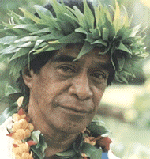
Papa Henry Auwae was kahuna nui la'au lapa'au
(expert healer) on Big Island, Hawaii. Martyn studied with him, and often quotes him,
e.g. "What's the point of healing
a disease if a person doesn't learn from the disease?"
and "Your health reflects your relationships!" Papa Henry
dedicated most of his life to healing - we think of him as Godfather
of Soulwork. Papa Henry's philosophy is reflected throughout our coaching,
particularly in ho'oponopono
(healing relationships, see Systems 1)
and changing relationship bonds (ele'ele eke) (Systems 5).
See Hawaiian Shamanism.
Dr Gregory Bateson was an anthropologist who also studied schizophrenia,
and applied cybernetic and systems theory to his work (see Steps to an
Ecology of Mind). Bateson's description of logical types (called
logical levels in NLP) define a hierarchy of abstraction that
includes beliefs, values and identity.
As relationships have a higher level of abstraction than individual
identity, we coach people to ground and stabilize identity changes in their
relationships - hence we very often follow individual coaching with relationship
work, particularly couple coaching, family coaching or team coaching.
Dr. Milton Erickson was an American psychiatrist who redefined
medical hypnosis (which had been ridiculed by Dr Sigmund Freud). Although
crippled by poliomyelitis, Milton Erickson became expert in noticing and responding
to non-verbal communication, constructive provocation and creating healing
metaphors. (See Uncommon Therapy by Jay Haley.) Martyn uses and
teaches these skills throughout his trainings, particularly in isomorphic and
interactive metaphors (Systems 3) and in provocative
coaching and therapy (Systems 5).
Dr. Victor Frankl was known for developing Logotherapy - an
existential psychotherapy - inspired during his imprisonment in Nazi
concentration camps during World War II. Much of the philosophy he presented
in Logotherapy is reflected in our coaching and training, particularly in
assisting people to search for meaning and integrity
as a basis for change. Dr Frankl's philosophy is reflected in Martyn's provocative
coaching (Systems 5) and
in ways to stabilize integrity (Systems 3).
Dr Clare Graves was a post-doctoral student of Abraham Maslow.
Dr Graves described "values" as a basis of human evolution and
created a useful model of societal evolution that predicts the behavior of
individuals, groups and organizations. Dr Graves work is integrated into
Soulwork, particularly into goal coaching, mentorship
(Systems 7)
and team coaching. For more on
Graves' work, click HERE.
Annegret Hallanzy lives in south Germany where she created a synthesis
of NLP with psychotherapy - Vision Oriented Changework or VoVa.
Annegret's work inspired our Goalwork Coaching (Systems 2) and Couple Coaching
(Systems 8 - see
Relationship Bonds).
Annegret wrote about her synthesis in her book Ekologie NLP Redefiniert
(NLP Ecology Redefined) - which we recommend to NLP practitioners who can read
German. This book evaluates the ecology and consequences of many NLP techniques
and introduces VoVa. Here is an excerpt from her book
NLP
Ecology Redefined.
Another German therapist, Bert Hellinger helped redefine brief
psychotherapy by examining spatial positions of relatives in people's subjective awareness. Hellinger's books on family constellations describe the effects of family actions on
a family member's perceptions of reality. We appreciate Bert Hellinger's concepts
about relationship responsibilities and entanglements (included in
Systems 1).
Aunty Mona Kahele was a native Hawaiian kupuna (elder) skilled
in ho'oponopono (Hawaiian family therapy) and la'au lapa'au
(Hawaiian herbal medicine) which she was taught by her kahuna grandfather.
She lived on near Kealakekua, where, she helped many people resolve relationship and
emotional problems. Aunty Mona gave Martyn over 50 years of her handwritten
notes on healing body, mind and spirit and inspired him to translate the
healing ritual of ho'oponopono
into a more usable format for the West (Systems 1).
For more on the cultural beauty of old Hawaii, click
HERE.
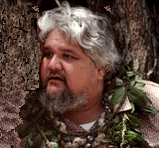
John Kaimikaua was a native Hawaiian expert on Hawaiian traditions.
Uncle John lived on Molokai - traditionally known as the "Island of
Sorcerers" - where he was taught by a mysterious kahuna lady. Martyn's
studies with Uncle John in Hawaii prompted his research
into the clarification of relationships with dependent, aggressive and deceased
family members (see Systems 6)
and taboo relationship bonds generally
(see Systems 5).
For more about Uncle John, click
HERE.
Ronald D Laing (MD) described mental diseases as social imbalances,
rather than biochemical imbalances, and
argued that mental disease symptoms make sense in their family contexts.
(See: The Divided Self). He wrote about communication in
dysfunctional families and described the effects of family behavior on the
member's perceptions
of reality.
Martyn incorporated some of Dr Laing's philosophy about family politics and
disease (Systems 1); family meta-rules
(Systems 5)
and Dr Laing's perception that insanity is a sane reaction to insane
situations. (Dr Laing wrote "Family patterns are not
laid out in front of us like the stars in the sky" (Massey
Lectures II, 1969) - although our systemic diagnosis does exactly this!)
Aunty Margaret Machado,
a native Hawaiian healer, famous for
her expert knowledge of lomilomi (massage) and la'au lapa'au
(herbal medicine) lived in Kealakekua on Hawaii's Big Island where she was
trained by her kahuna (expert) grandfather. Her teaching inspired
the "Soul to Soul" relationships which are central to our coaching.
Martyn lived for a time with Aunty Margaret and her family while
studying lomilomi with her in Hawaii. Margaret's daughter Nerita Machado now
continues her mother's tradition.
Dr. Murray Bowen
Dr. Murray Bowen developed a theory of human
functioning based upon studies of the natural sciences and his research.
Called a family systems theory, Bowen theory is a natural systems
theory distinct from general systems theory,
psychiatry, medicine, psychology or group theories in sociology
and sociobiology. Bowen Theory helps predict interactions of systemic variables
in human families that affect individual maturity and family health.
See Systemic Change
Professional Conversations: Coaching, Counseling & Therapy
The term coach arose at Oxford University
as slang for a tutor who carried a student.
Coaching was influenced by and used in sport, personal
development, adult education, psychology and leadership skills. Since Martyn began developing Soulwork in the 1990's, a number of
coaching associations seem to be striving for dominance. See
Philosophy of Coaching.
Although the conversations called coaching, consulting, counseling,
psychotherapy and psychiatry overlap considerably, the word coaching
better describes our work than counseling, etc. We are probably more
eclectic than psychologists or psychiatrists, who may be limited by the
models of consciousness usually taught at universities and expounded in the literature.
The following table
compares these helping styles with reference to nonverbal objections and
relationship transferences.
| |
Time |
Focus |
Goals |
Objections |
Transferences |
Resources |
| Psychiatry |
Decades |
Biochemical homeostasis |
Provide mental homeostasis |
Overcome with authority |
Use to increase authority |
Medications |
| Therapy |
Years |
Family of origin |
Reorganize personality |
Research causes |
Utilize |
Analysis |
| Counseling |
Months |
Reality of life demands |
Cope with life problems |
Avoid & minimize |
Minimize |
Life Skills |
| Consulting |
Weeks |
Complex problems |
Solve business problems |
Logical arguments |
Ignore |
Training & Business Experience |
| Life Coaching |
Weeks |
Simple successes |
Success in Life |
Dissociate & ignore |
Ignore |
Coach Training |
|
Systemic Coaching |
Days |
Sense of life |
Emotional Maturity |
Accept &
integrate |
Dissolve |
Systems Training & Expert
Modeling |
NLP is known for hypnotic communication, influence skills and modeling.
Martyn was certified as a NLP trainer by four NLP training institutes, and
he taught NLP until he investigated the long-term consequences of NLP.
He adapted from NLP some concepts of non-verbal communication (taught in
Systems 2), notions about timelines and
re-imprinting (taught in Systems 6)
and modeling subjective behavior.
He most often honors the contributions of Steve and Connirae Andreas,
Robert Dilts and Dr Wyatt Woodsmall.
(See Comparison
of Huna, Soulwork and NLP & Meta Model)
Human systems appear to develop a conscience which demands balance and
justice. Systemic diagnosis and systemic coaching can reveal how disease,
conflicts and mental problems originate in relationship disappointments and can
be solved with relationship coaching ... even with dead people.
Systems theory was first proposed in the 1940's by Ludwig von Bertalanffy,
who noted that only systems that interact with their environments can
evolve. Systems theory focuses on relationships between parts or members of
complex systems and subsystems - and how these relationships shape a system's
behavior and survival potential.
Systems can stabilize or destabilize themselves by exchanging matter and
energy with other systems or with the environment, as the systems develop or transition to more
complex configurations. Hence self-organizing systems can increase or
decrease their survival potential. Models from systems theory are
integrated throughout our systemic coaching
and training. See Systems Theory
and particularly Chaos Theory.
Phineas Quimby was the most well-known American mental healer
in the late 1800's, credited for healing 15000 people. Quimby's manuscripts
about his science of healing were the basis for the New
Thought movement, which was later promoted as Positive Thinking.
Quimby's science of healing opposed religion, education and medicine, which
Quimby perceived as sources of toxic beliefs. Martyn integrated Quimby's work
on beliefs into Systems 5 (see
Model of a Healer).
In 1863, Quimby's patient, Mary Patterson, whom Quimby
had healed of spinal cancer, borrowed Quimby's manuscripts and
taught his material as her own. She later remarried twice to become
Mary Baker Eddy, who founded her Church of Christian Science
based on distorting Quimby's work. Some things don't change.
Virginia Satir
Virginia Satir provided models of family constellations, in which
she emphasized the use of humor and paradox. Her assumptions about functional,
fragmented identity parts encompassed both conscious and unconscious processes.
You will find reflections of her love of humor and paradox throughout our
coaching and training. Martyn teaches applications of her work with families in
Systems 4.
Czech it Out
In Czech Republic - once known as Bohemia and later the west side of
Czechoslovakia - Martyn often taught in Prague where he worked with
Daniel Franc
(internet wizard), Daniel Martin
(medical doctor) and Pavla Francov� (a blind artist who thinks in colors).
(If you go to Czech, don't miss Česk� Krumlov).
Polish Support
Martyn visited Poland to teach NLP with
Annegret Hallanzy, a
family therapist, and later to share his research into Hawaiian
shamanism. He met some wonderful people during this synthesis period
including Maryla Biernacik
(organizer), Ewa Foley (trainer),
Monika
Zubrzycka-Nowak (psychologist),
Katarzyna Jaskiewicz
(artist), Edward Rodziewicz (engineer) and
Krzysztof Banasik (businessman).
Croatian Friends
Croatia is justly famous for its beautiful islands, national parks and
friendly people. Martyn's Croatian friends helped him integrate the pieces of Soulwork
during the early years, especially Nenad Maljkovic (organizer),
Zrinka Buljan (medical doctor), Mara Doljak (therapist / trainer),
Tomislav Budak
(trainer / musician), Radojka Ligotić
(psychologist), Kre�o Homan (therapist) and
Kosjenka Muk (trainer / therapist).
Their integrity, insights and sincere encouragement continue to provide
great support.
Online Coaching with Martyn

|