|
Chaos, complexity and catastrophe
theories are sciences that provide models
which
can regenerate coaching, counseling and therapy. Our
systems approach applies these models to human
identity, values, beliefs and behavior.
We help people renew their experience of self,
while changing limiting beliefs and habits.
Instead of trying to change life according to some egotistic, dogmatic
or statistical models, we accompany people who want to live with integrity.
Continued in Chaos Coaching - Part 2
Chaos in Coaching & Counseling
 |
For millennia, our ancestors pondered the
creation of order. They created simple stories to describe the emergence of
stable systems from chaos.
These early stories comprise primitive
chaos theories that eventually lead to
quantum thinking and
systems theory.
|
In the 14th century, William of Occam
criticized people who created complex explanations for simple phenomena,
saying "Do not multiply entities needlessly". This Occam's
Razor, helped people "cut" through complex theories. In the 20th
century, Albert Einstein updated this, saying, "Make
everything as simple as possible - but not simpler".
|
Kumulipo Chant
Hawaiian
(translated) |
When space turned around, the earth heated
When space turned over, the sky reversed
When the sun appeared standing in shadows
To cause light to make bright the moon
|
Classical physics was based on deterministic descriptions of nature, and lacks distinctions
between past and future. Although such a universe would be ruled by
deterministic laws, our macroscopic world is not reversible. (This was ancient
Greek Epicurus' dilemma between being and becoming, an idea that chance allows
flexibility rather than rigid predetermination.)
Chaos theory can be applied to human relationship systems
such as families and teams. The emerging field of systemic coaching provides
massive insight into the behavior of members of human systems. Applications of chaos theory in the social sciences can
unite physical, emotional, mental and spiritual realities - if (and only if)
we can let go of classical, pre-systemic notions.
The behavior of complex systems is not random,
rather the final states are so sensitive to the initial conditions that
it is impossible to predict the future behavior of complex systems
without near-infinite knowledge of all motions and energies (i.e. the
so-called Butterfly Effect postulates that a butterfly in South
America might influence storms in the North Atlantic).
|
Eric Poincare, a founder of modern chaos theory, wrote in
1882 "It may happen that small differences in the initial
conditions produce very great ones in the final phenomena".
Poincaré used the term bifurcation to describe the
emergence of multiple potential stable solutions.
Poincare's work infers that if all outcomes have a
similar chance of manifestation, then chaotic outcomes will manifest
more frequently than desired outcomes - as more
chaotic possibilities can result from tiny differences in the
initial conditions. |
Poincaré's perceptions are relevant to human goals
in human systems. Civilizations rise and fall, but never in the same
way twice. Minor experiences of individuals can lead to
unpredictable changes in the world. Do you remember the childhood story ...
for the want of a nail ... a kingdom can be lost?
Lies, Damned Lies & Statistics
Before chaos theory, scientists could not analyze complex
systems, and could not predict chaotic behavior, even with detailed
knowledge. To avoid complexity, scientists assumed that behavior in
complex systems was linear, and used statistical analysis to assess
and predict the behavior of populations. In a pre-systemic world,
individual contributions to population statistics are ignored.
If individual
excellence is smeared across populations,
then social sciences are (by
definition) sciences of
mediocrity.
 |
If human systems were linear,
babies could smoothly transform into adults; businesses could easily
change from making candles to making computers; and countries could
gently shift from fascist to democracy.
Periods of chaos are normal in living systems.
During chaotic times, unexpected opportunities compete for survival
in changing environments.
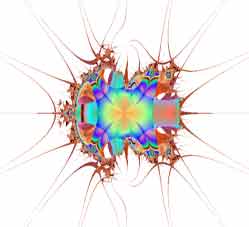
Order within Chaos: fractal by Martyn Carruthers
2003 |
Assumptions of linearity and obsessions with statistics
provided scientists with temporary patches until the discovery of the universal
properties of non-linear, complex systems. But classical assumptions are
still used to blur individual expertise across human populations.
The sciences of human behavior, which could become our greatest
human achievement, remain dull, weak and manipulative.
Temporary statistical patches, like temporary taxes,
dominate social scientists. Yet individual human excellence can be
modeled and replicated with Expert Modeling,
one basis of our systemic coaching. See also
Quantum Thinking.
The I of Identity
Your subjective experience of your objective reality - your map of the world - your answer to the question,
"Who am I?" is reflected in your behavior. Your every
action is a hologram of your life and reflects your perception of
reality - hence your perceptions are largely bounded by past
events. You live in a phase space.
|
Phase Space
& Strange Attractors |
A system confining an entity
and its relationships (phase space) contains vast enfolded
information. The organizing principles of a phase space are
called attractors. As complex systems are both
unpredictable and patterned, organizing principles in a complex phase space
are called strange attractors. |
Without the need to solve complex problems, there
might be no human personalities. There might be many bodies and no
reason to label individuals. A bee-hive society would lack a phase
space in which individual differences are important ... and such a society would
be unable to choose its own future.
Your behavior is predictable within the limits
imposed by your perception of your environment. No matter how much you
think, you are unlikely to leave the safety of your thoughts. You stay
within the confines of your beliefs. Your beliefs act as attractors of
your attention and limit your possible actions.
As complex systems can now be modeled with computers,
chaos theory is widely applied in technology. Strangely, this is largely
ignored by social scientists and helping professionals, for whom complexity
remains hidden under pre-systemic assumptions of linearity and obsessions with
statistics. Like chemical catalysts, human agents of change often resist changing
themselves.
Phase Transitions at the Edge of Chaos
You can adapt to your environment and to changing
conditions - within limits. Yet, like all self-organizing systems,
you are on the edge of chaos - close to a phase transition
in which either you or your environment change in ways that you
cannot control ... and perhaps in ways that you cannot survive.
|
When chaos intrudes on your life, when you are overwhelmed
by a crisis, you can collapse with fear and retreat into addictions, depression
or psychosis. Or you can embrace change with courage, and transform with joy.
We can
help you transcend your old boundaries and find
new ways of being.
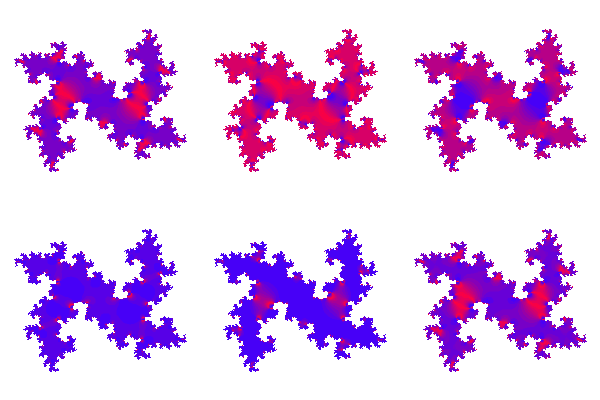
Phase Transition |
|
The edge of chaos is a critical point of a system.
During a phase transition or crisis, minute changes can either tip the
system into chaotic behavior or into stability. During a crisis, tiny
details from your past or present can have enormous (and statistically
unpredictable) impacts on your future.
Crisis provides motivation - not only for you to
change - but for you to transform. During a crisis, you may surprise
everybody, including yourself, with solutions that shorten or prolong
your survival. However, you are unlikely to find such innovative solutions on
the logical pathways that you know well. You must be willing to step into chaos
... and we can accompany you.
Chaos Coaching
We often help people experience a strange attractor - integrity - by exploring
their personal realities to find a profound sense of self. This journey
often leads to a series of unusual experiences - which we often refer to as
ecstatic states.
|
I found a place of nothing and
everything ... I could see and feel and touch options I had not considered nor
even imagined possible ... I found a life goal that I never knew and always
sought ... as I explored the possibilities of existence I found my true self. |
At the edge of chaos, when little makes sense and
everything is possible, miracles can happen. But hoping for a miracle
does not ensure survival. Survival requires endurance, a benefactor and transformation.
Survival often requires a change in identity that helps you
manifest previously unimaginable solutions.
|
The edge of chaos is the edge of
miracles ...
and the edge of insanity ... and the edge of life.
|
An edge of chaos perspective can be scary - and empowering.
We help people create perturbations - imbalances
which can bring them back into balance. With our chaos coaching we can help
people explore the cutting edge of reality ... and the edge
of chaos. We can accompany you as you restructure your identity and find
systemic solutions for complex and chaotic problems.
Chaos Coaching - Part 2
Online Coaching & Mentorship
Plagiarism is theft. Copyright ©
Martyn Carruthers 2003-2012 All rights reserved
|