|
I first visited Pu'uhonua as a tourist, with
no idea that this place would become so important to me. I enjoyed a
peaceful walk around the park, took a few photographs and left without
thought of return. A month or so later I returned with David Kawika Blaikie of
Honolulu and participated in a huna ritual which influenced me strongly
and motivated me to study Hawaiian healing.
The Elder Gods of Hawaii
The old gods of Hawaii - the akua and the ancestral
'aumakua - were often credited with guarding people, families and
villages. Before the illegal American takeover of Hawaii, most native Hawaiians
worshipped four principal gods. They were: Kane, god of the sun and the
heavens; Kanaloa, god of the ocean; Ku, god of the wild
places and warfare; and Lono, god of the land and of weather.
Some Hawaiian people from the Kona district of Big Island
considered Lono to be 'aumakua (deified ancestor), as
he was once a chief of Kealakekua.
Some Kona Hawaiians numbered Lono amongst their original ancestors,
and still ask him for blessings. Across much of Polynesia,
Lono (also called Rono and Rongo in the south) was respected as
akua - as one of the highest gods.
The main temple of Pu'uhonua o Honaunau
remains dedicated to Lono. Outside it are many tiki (statues)
of Lono in various aspects. Lono was respected as an
advisor and healer. Lono could be invited to festivities and
feasts and his help could be sought in times of crisis. Lono
could be asked to solve community problems and heal diseases. Lono
could also punish a community with drought.
|
 |
Pu'uhonua o Honaunau
is a famous sanctuary of pre-Christian Hawaii that has been
partially restored. It is about 30 km south of Kailua-Kona. This
image shows the Hale o Keawe (built around 1650) at
sunset on Honaunau Bay. |
Ho'oponopono .
Huna,
Healing and Ohana .
Kumulipo .
Soulwork
Pu'uhonua o Honaunau
Many royal chiefs (ali'i) of old Hawaii lived
near Honaunau Bay, next to an ancient temple complex. A pu'uhonua was a
place of refuge where defeated warriors and breakers of the stringent kapu
(taboo) system of sacred laws could be cleansed or forgiven (kala)
of their sins (hewa).
Under the kapu system, sins could include touching a chief
(or even stepping on a chief's shadow), a woman eating a food designated for men
(e.g. most types of banana) or eating a bird or fish out of its regulated season.
Although punishments could be severe, the spirit of a pu'uhonua was
respected and those people cleansed there could freely return to their 'ohana
and families.
|
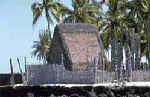 |
The Hale
o Keawe has been restored and is maintained as an active place of
Hawaiian worship. The tiki (statues) of Kane and
Wahine near the temple (heiau) represent the highest male
and female deities - the active and passive principles of creation.
Other tiki represent guardian akua (spirits). |
Within 30 years of the arrival of Captain Cook
(thought to be the return of the god Lono by some native Hawaiians),
the old temples (heiau) were abandoned and the strict kapu laws were
replaced by strict Christian laws (idleness could be punished by 2 years of
forced labor, building roads to fruit farms). Much later, after 150 years of
neglect, Pu'uhonua o Honaunau was designated a national park.
|
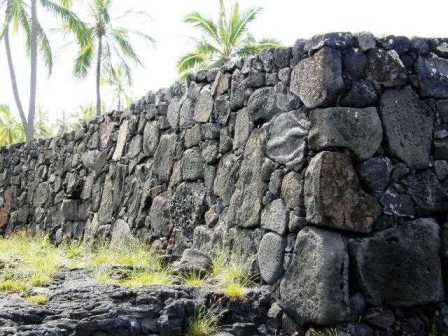 |
The great wall around
Pu'uhonua o Honaunau was built about 1550 and is up
to 10 feet / 3 meters high and 1000 feet / 300 meters long. |
The kahu (keeper) of the old pu'uhonua heiau
(temple) while I was in Hawaii was Lanakilakahuokalani Brandt. Lanakila was a
kahuna pule of the order of Lono (deity of agriculture and
healing). He had a shop in the village of Kealakekua in which he made and sold
traditional Hawaiian musical instruments.
To stay relevant, sacred
traditions can evolve to meet the changing realities of life. Lanakila
I enjoyed meeting Lanakila in his little shop
when driving through the
village. Kahu Lanakila
Brandt was the only kahuna of Lono that I knowingly met, and he was an authority
on aloha, ho'omana and la'au kahea. Sadly, Lanakila's
old body died in December 2005. I offer gratitude to his spirit.
|
Aloha is a complex and important word of
near unlimited powers. But its greatest power and beauty is that we all have
it! We need only to open the floodgates and let it flow; let it inundate all
within our individual spheres. Then truly will each of us be living within
"that internal paradise, the spirit of Aloha". Lanakila
Brandt
|
 |
Hawaiian Family Therapy - Ho'oponopono
Ho'o means to do or to make and ponopono
means �to make right; to order, to correct.� I find that Honaunau is a GREAT
place for ho'oponopono (although the park guards prefer that you wander around
aimlessly rather than do something useful there). The ritual traditionally began with
prayers and ended with a meal (lu'au) and exchanging Hawaiian flower necklaces
(lei).
If guilt is believing that you did something bad; then shame
is believing that you are bad. Shame is believing, "I am worthless and
I can never be lovable". Shame conveys that you are not a member of your
community. Ho'oponopono is about resolving both guilt and shame. Sadly, it has
been greatly distorted by Western trainers and writers.
Ho'oponopono can correct, restore
and maintain healthy relationships by cleaning (kala) the causes and guilt
and sources of shame. Usually the most senior family member or respected elders
gathered a family together. Family members were expected to cooperate and work
through problems. During ho'oponopono, all feelings
were acknowledged and periods of silence allowed time for reflecting on the
causes and consequences of suffering. Then confession, repentance and
forgiveness could take place.
Many of the old Hawaiians believed that health and disease reflects
relationship issues - which included relationships with the dead, the angels and
the gods. Ho'oponopono provided space for people to end and
clean up relationship conflicts - guilt, shame, hurts, regrets, errors, disappointments
and secrets - and to end their sick influence over health, family happiness
and community harmony.
Lono Makahiki Festival
Lono, like other Hawaiian gods, could take on many forms
(kino lau), such as the kukui tree and other plants, the rain clouds,
and the pig (pua'a), whose dark bulk resembled certain dark clouds
(ao) called pig clouds). For farmers, the rites of the makahiki
festival assured rain. For chiefs, the makahiki offered an
opportunity to gather tribute and taxes.
After makahiki, the
akua loa, the image of Lono was decorated. A wooden staff, at
least 4 meters long, was mounted with a small carved head. A longer cross
piece was tied to the upper part of the staff, with leis and feathers.
A piece of white tapa cloth, of about 15 to 20 square meters, was
hung from the cross bar, rather like the sail of a ship. This image would
be carried clockwise around the island in a procession. (When Captain
Cook arrived - his ships seemed to be covered with Lono symbols).
During makahiki,
the chiefs would collect taxes, feast and sport while honoring Lono
for bringing rain. Games such as mokomoko (boxing) and
wai pu'u one (surfing) helped warriors to stay fit for battle.
The Night of Lono is the twenty-eighth
night of the lunar month. On this night, the thin crescent moon rises as
the Hawaiian dawn breaks. People prayed for rain on this day, and for melons
and ipu (gourds), which were kinolau Lono, embodiments
of the god Lono.
Conversations with Guardian Angels
If you lose contact with an akua or aumakua,
your awaiku (Hawaiian angels) can assist you to
rebuild these connections. However you may first need to reestablish and
clean (kala) your connections with your dead ancestors. Your ancestors and
your awaiku can help you connect (aka)
to your aumakua.
These rituals required offerings and chants. A chant of
summoning was followed by special chants for male and female lineage
aumakua. A long chant to summon aumakua began:
|
E kulou mai e na lani
E ho'olohe mai e ka honua
E haliu mai ho'i e na kukulu
Na 'aumakua i ka hikina a ka la a i kaulana
A mai kela pe'a kapu a keia pe'a kapu
Eia ke alana a me ka mohai
E mohai pilikia i ke akua |
Bend down, o heavens
Listen, o earth
Listen, o pillars of heaven
O aumakua at the sun rising and resting
From that sacred border to this sacred border
Here are our offerings and sacrifices
A troubled sacrifice to the gods |
Special offerings were appropriate when calling a Hawaiian
akua. The akua was given mana (power) to change
whatever troubled the community. Old Hawaiian chants to call an akua
often began by calling Kane, Ku, Kanaloa or Lono (supreme male gods).
Reconnection with awaiku, aumakua and akua
is possible, and is part of Huna Kalani. We introduce people to old Hawaii by
experiences of connection.
Mahalo ke akua!
Waipio Valley
. Pu'ukohala Heiau
. Aumakua
. Kahuna Training .
Awaiku
Hawaiian Spirituality
. Ho'oponopono
. Huna,
Healing and Ohana
. Kumulipo
.
Soulwork
E komo mai. Welcome. Come to Hawaii
and re-connect to your aumakua. Learn the old chants with us under the
trees at Puuhonua Honaunau. Swim with us at Waipio valley. Walk with us
into volcano craters in Volcano Park. Let us ride the winds together at Ka Lae.
Meditate with us deep inside a lava tube. And set yourself free.
Or will you help us come to you? Will
you help us bring the old teachings and magic of Huna Kalani to your part
of the world. If this idea interests you - email us!
Consider joining us in Hawaii. Our
classrooms are the beaches, forests and volcanoes. We can help you
find in Hawaii a journey of a lifetime. Come to the most beautiful,
most sacred (and most haunted) places on Big Island. Or help us bring
Hawaii to you.
Huna Kalani
. Soul Mentorship
Huna Kalani provides an experiential introduction to old
Hawaiian healing. You can experience the beauty and power of Huna Kalani in
a series of workshops that can expand your perception of reality. Hawaiian
magic refers to a technology that few understand. Within this old healing
magic are some of the roots of the systemic magic of Soulwork systemic
coaching.
|
Training in Hawaiian Shamanism |
|
Huna 1 |
Bringing Down the Sun: Ho'oponopono
& Ho'omanamana |
|
Huna 2 |
Elements of Nature: Honua, Ha, Ahi & Wai |
|
Huna 3 |
Dreamtime: Ho'omoe, Moe Uhane & Expanded Consciousness |
|
Huna 4 |
Advanced Huna of I'o, Kumulipo and
Awaiku |
|
Huna 5 |
Huna Experience in Croatia, Mexico or on
Hawaii |
Online Huna & Ho'oponopono
Plagiarism is theft. Copyright �
Martyn Carruthers 1998-2011 All rights reserved. |