|
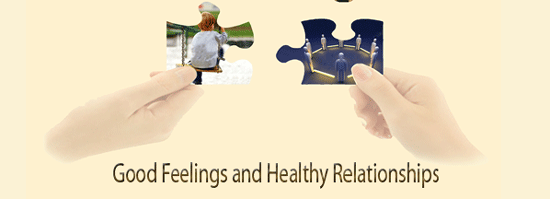
When we help people improve their lives, we ask about their feelings,
emotions and relationships.
For many women, talking about feelings
is a luxury. For many men this is more like a punishment.
Self Diagnosis & Healthy Relationships
If you ask us about our Soulwork coaching, we will ask
you about your goals. Once we know what you want, we can explore where you
are now and how you can get there from here. This includes recognizing
which, if any, of your beliefs and emotions block you achieving your
goals, and which relationships you want to change.
Assessing emotions often seems easier for women, as men
may have been taught not to talk about or even not to feel
their emotions. Some people, usually male, have told us that the only
emotions that they allow themselves to feel are motivation and stress.
Every relationship includes conflicts and disappointments, and
it can be difficult to evaluate conflicts and handle disappointments when you
feel strong emotions bubbling inside you. When that happens, your actions and
their consequences may be overly influenced or even controlled by your emotions.
(We have tested our methodology in many countries,
and we find it to be valid across cultures, even with people who
know little of Western psychological theories.)
Are You your Emotions?
Our emotional diagnosis is neither psychological nor
medical - it is rather a way to evaluate feelings and emotions and
predict the likely consequences. Here is a quick self-check:
- Do you accept each emotion as a communication?
- Are you aware of your emotions ... do you feel them?
- Do you label each emotion and find what name fits best?
- Do you know which relationships generate which emotions?
- Do you know what behaviors or actions each emotion
motivates?
- Do you validate your emotions and find in what contexts
they are appropriate?
Are You your Relationships?
Our relationship diagnosis is a way to evaluate
relationships and disappointments so as to predict the likely
consequences. Here is a quick self-check:
- Do you define and plan relationship goals?
- Do you recognize who you can probably trust?
- Do you test your evaluations using other modalities?
- Do you define relationship goals - with other people?
- Do you recognize your own objections to happiness?
- Do you test whether your words match your feelings?
- Do you check the consequences of possible actions or inaction?
- Do you ask questions neutrally, without favoring certain
answers?
- Do you listen to people's answers, without distorting
their answers?
- Do you recognize transferences, transference loops and
identity loss?
|
Who Are You? |
Are You your Self-Image?
How do you see yourself?
How do you like, respect and value yourself?
What are important statements about yourself?
How would you describe yourself to a stranger? |
Are You what you Learn?
Do you keep on learning?
Do you seek feedback from others?
Do you accept feedback and learn from it?
Do you seek other meanings and possibilities? |
Are You your Success?
Do you normally get what you want?
Do you often let people sabotage you?
Do you often sabotage your own success?
Do you often visualize yourself succeeding? |
Are You your Power?
How well do you influence people?
Do you share information with others?
When would you call yourself an expert?
Are you a good role model for other people? |
Are You your Problems?
Would people describe you as tolerant?
Do you look for problems or opportunities?
Would people describe you as judgmental?
What do you do if someone disagrees with you? |
Are You your Conflicts
Are you easily angered?
Do you avoid confrontations?
Can you calm irritated people?
Can you control your emotions? |
Are You your Discussions?
Are you easily convinced by other people?
Are you easily put off if someone says, “No”?
Can you persuade others to your point of view?
Do you take things personally (especially, “No”)? |
Are You your Motivation?
Do you often show initiative?
Are you mostly proactive or reactive?
Do you think of possibilities or limitations?
Do you take responsibility for your decisions? |
Are You your Communication?
Are you a good listener?
Do you ask good questions?
Can you summarize what people say?
How would you rate your communication skills? |
Are You your Passion?
Do you give up easily?
Are you easily disheartened?
Do you normally overcome barriers?
Are you passionate about your goals? |
Are You your Changes?
Can you express discomfort?
Can you cope with uncertainty?
Can you easily accept change?
Can you easily handle ambiguity? |
Are You your Decisions?
Do you take effective action?
Can you solve most problems?
Can you easily make decisions?
Do similar problems keep happening? |
Are You your Integrity?
Does your life make sense?
Do you know your life purpose?
Do you consider yourself to be special? |
Are You your Ego?
Do you ever doubt yourself?
Do you really listen to other people?
How do you respond to criticism? |
If you ponder your answers to any of the above questions, you may understand
better who YOU are and who you are not, and how much you have identified with
your beliefs, behavior and other people. We can help you rediscover who YOU are,
if you wish.
Goal Diagnosis
Do you know your key goals?
Have you prioritized your goals?
Do you regularly reset your goals?
Can you motivate yourself to action?
Few people can answer the question, "What do you want?"
with a single, specific, timed goals with a flexible plan to actualize their goals.
We use our goal diagnosis to identify the potential consequences and
side-effects of achieving goals and of the strategies for achieving those goals.
Together, relationship diagnosis and goal diagnosis can help most
motivated adults
find appropriate and realistic goals and appropriate strategies and plans for achieving
their goals.
You can test the validity of a goal or any step towards its achievement
logically, emotionally and non-verbally. You can test the desirability of
the consequences of achieving a goal, any verbal or non-verbal
objections to that goal (or to the strategy for achieving it)
and to success in the goal context.
Psychobiology of Soul
. Coaching & Chaos
. Quantum Coaching
Entanglements & Identity Loss
By systemic relationship entanglements we refer to unwanted
emotional confusion or bonds between people, usually unpleasant
feelings or beliefs based on past injustice and guilt. Entanglements
can generate enormous suffering, and are both the cause and effect of
abnormal relationship behavior. The consequences of entanglements
include depression and illness.
Entangled people often ignore or excuse their own problematic behavior.
They blame others, complain and justify their entanglements. Most people
will suffer long before they seek relationship coaching that can dissolve
entanglements. (For most people, suffering seems to be an
essential step to health.)
Depression can also follow entanglements with cults and cult-like
organizations (e.g. military, multi-level marketing, some government
agencies). Our Exit
Coaching can help people disentangle from unhealthy groups and
organizations, from past counselors or from
damage by therapists.
Helping professionals and managers who can recognize the
behaviors associated with identity loss
can predict problems, get help early and
protect people and organizations from unpleasant consequences.
In any family (or other human system), people are alert to
justice and guilt, and respond to perceived injustice following the
examples set by parents and grandparents. We refer to some common
responses to injustice and disappointments as identity loss: We
help people find themselves.
- Cannot change behavior
(Identity Bonds)
- Cannot express own life choices
(Identifications)
- Cannot make decisions without conflict
(Identity Conflict)
- Cannot describe, feel or express emotions
(Lost Resources)
What do you want?
We start with your goals ... and we finish with your success. We
listen carefully to your answers, and if possible we watch carefully
how your body answers. This requires the diagnostic skills (goal
diagnosis, relationship diagnosis and non-verbal diagnosis)
that we often teach to coaches and therapists.
Soulwork diagnosis can help you assess and predict your relationship
behavior, so that you can better evaluate your relationships, beliefs
and emotions; and find the information you need to define, plan and
fulfill your goals.
We can help you to
evaluate your emotions and change your relationships. It provides
valuable relationship information in a short time that you can correlate,
test, confirm and integrate using our other systemic coaching tools.
Contact us to understand and change your emotional blocks
and improve their relationships as they step towards your goals.
Online
Coaching, Counseling & Soulwork Training
Plagiarism is theft. Copyright ©
Martyn Carruthers, 2005-2012 All rights reserved.
|